Antique Ceramics
Dated 16thC Italian Renaissance Maiolica Wet Drug Jar 'A. DE. BVGALOSSA' 1545
Dated 16thC Italian Renaissance Maiolica Wet Drug Jar 'A. DE. BVGALOSSA' 1545
For items over £500 we require payment via bank transfer unless otherwise agreed.
Couldn't load pickup availability
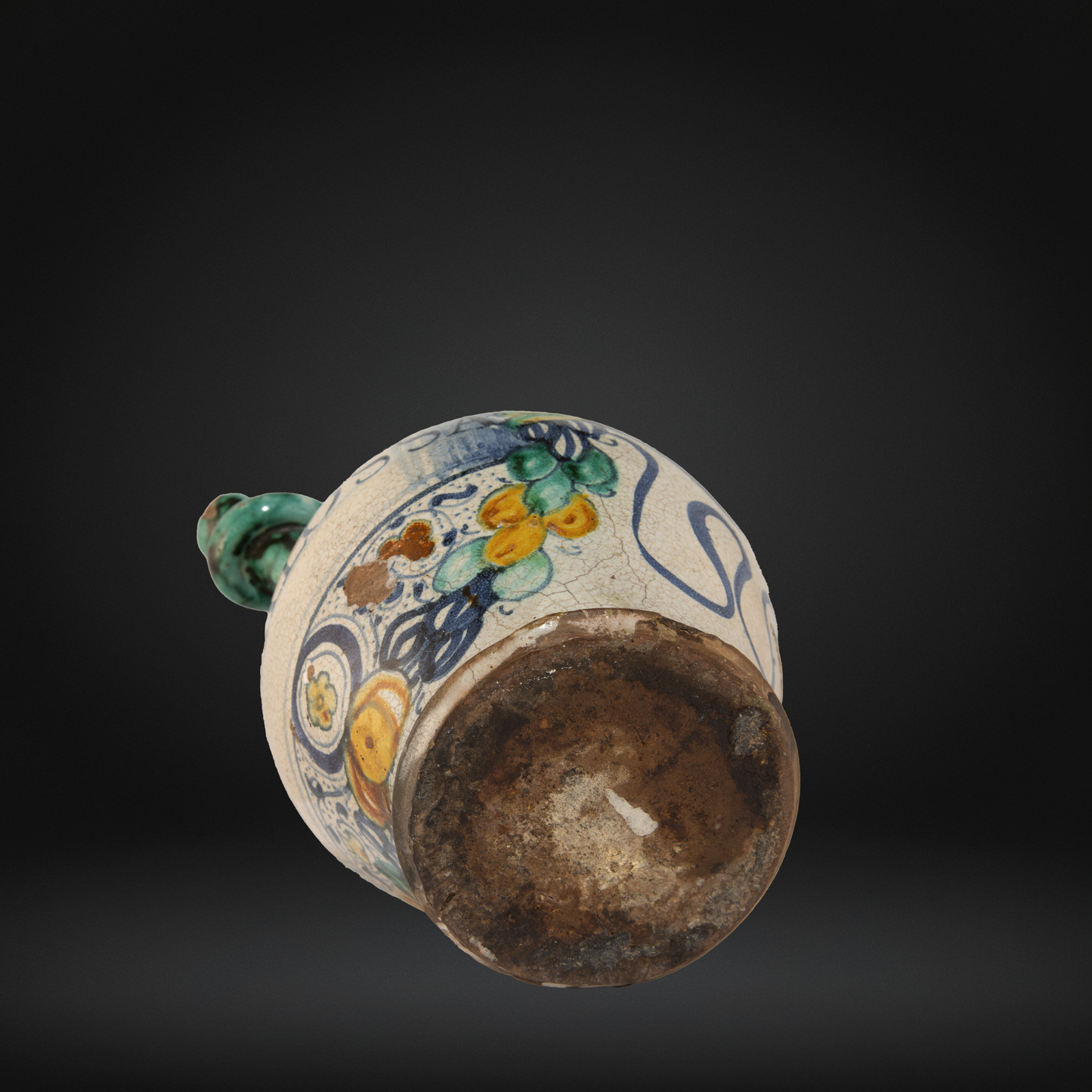
A rare Italian Renaissance maiolica wet drug jar, boldly dated 1545. The elegantly proportioned ovoid body is centred by a prominent pharmacy label inscribed “A. DE. BVGALOSSA”, denoting its original contents, and along with some scrolling motifs, is set within a fruiting wreath. The wreath is accented by graceful flourishes of blue ribbon that fill the reserve with rhythmic movement and colour contrast.
The form is both sculptural and practical: the pronounced spout, supported by a distinctive rope-twist moulding, reflects the vessel’s intended use for dispensing liquid preparations, while the simple yet robust strap handle provides balance to the composition. Beneath the handle, the large, confidently painted date 1545 anchors the piece firmly within the mid-sixteenth century, enhancing both its documentary and historical significance.
Rich in character and emblematic of Renaissance apothecary wares, the jar combines vibrant tin-glazed surfaces with refined ornamentation, embodying the artistry and functionality of Italian maiolica at its height. A striking and highly collectible example of early pharmaceutical ceramics.
18.5cm
Note: Bugloss (Anchusa officinalis) was a medicinal herb (similar to borage) valued in Renaissance pharmacy for its “cordial” properties. Commonly prepared as syrups or distilled waters, it was believed to strengthen the heart, lift melancholy, and restore the spirits, in keeping with humoral medical theory.
UK shipping included.
Condition: Sound original condition. With some glaze loss and chips, particularly around the spouts. Dark crazing. Firing flaws, one of which is a large pebble inclusion which caused the glaze to blow. Shallow chip (below the O). Note: some very tight hairlines and darker lines in the crazing - difficult to see even under UV and not visible through the interior.
Share