Antique Ceramics
Medieval Heraldic Encaustic Floor Tile, Royal Portrait of a Crowned Queen - 14th Century
Medieval Heraldic Encaustic Floor Tile, Royal Portrait of a Crowned Queen - 14th Century
Couldn't load pickup availability
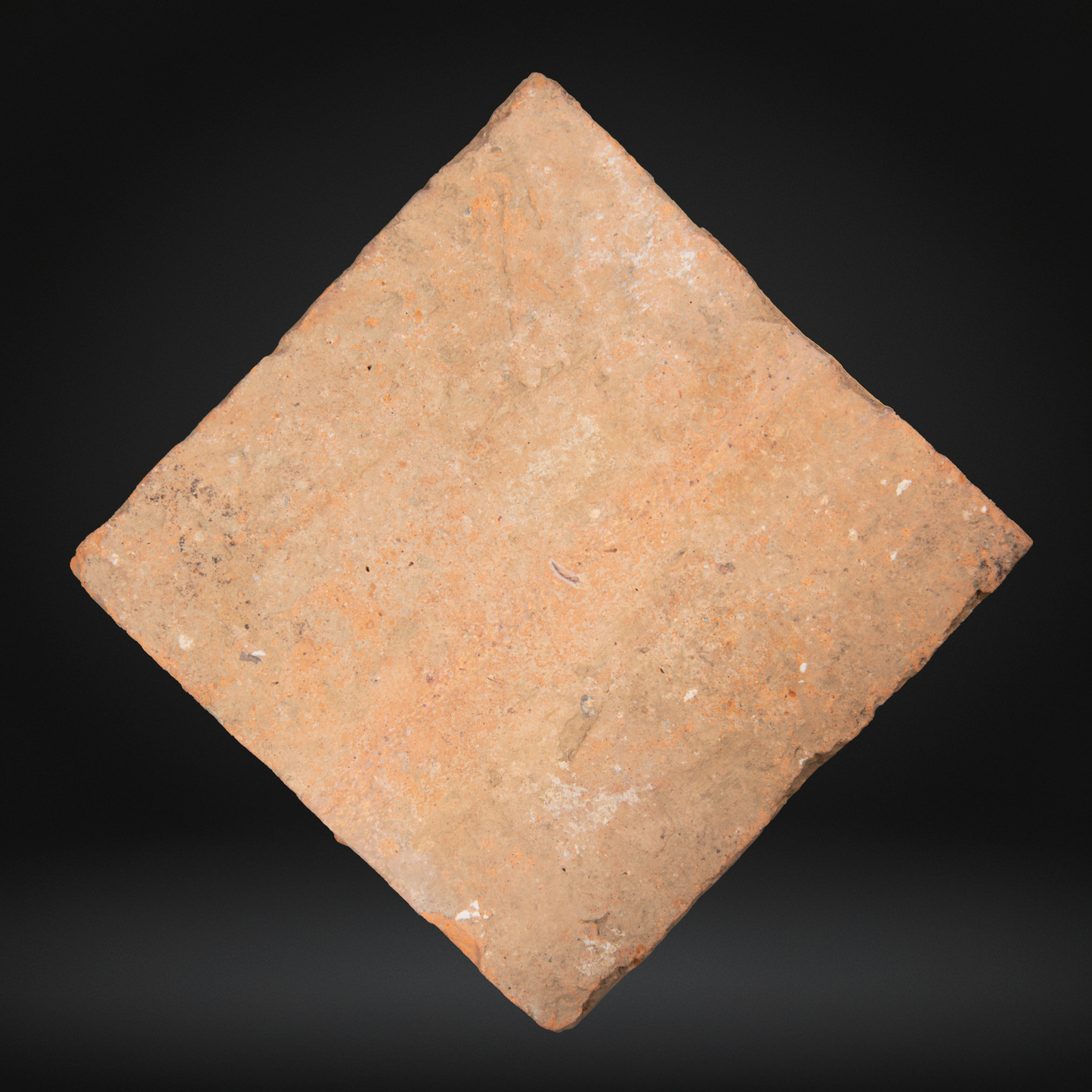
A rare lead-glazed Medieval earthenware floor tile depicting the three-quarter bust of a crowned female figure, conventionally identified as a queen, enclosed within a lobe formed by double concentric lines. This design belongs to the well-documented corpus of medieval floor tiles from Artois, closely corresponding to examples excavated at Hermelinghen (No. 183) and Thérouanne (No. 304), where it is associated with a companion tile depicting a crowned male bust. Together these formed part of a decorative programme of repeating royal or noble portraits
Busts of crowned figures constitute one of the most distinctive decorative themes in fourteenth-century Artois tile production. While male heads are comparatively standardised, female figures display greater variation in pose, hairstyle and costume, reflecting contemporary courtly fashions. This figure is shown with her hair drawn back into a bun contained within a hairnet or tasselled coiffure, secured beneath an elaborate headdress by a braided cord. She wears a fur-trimmed tunic fastened at the neck and a collar of lozenge-shaped jewels, while her crown is ornamented with a central cabochon. The refined modelling and carefully observed costume exemplify the sophisticated figural tile production of northern France during the fourteenth century. Jean Boucard has suggested that the coiffure represented here corresponds to fashions of approximately 1365–1370, although securely excavated examples indicate that the motif belongs more broadly within the later fourteenth century. Related crowned female heads are also known from Saintonge and Bress-Allonnes, demonstrating artistic connections between northern and western France, while comparable crowned busts appear on medieval tiles in the collections of the British Museum and Canterbury Museums, attesting to the widespread influence of this iconography.
The depiction of crowned heads was not confined to ceramic decoration. Contemporary documentary evidence records that the apartments of Count Robert II at Hesdin Castle were ornamented with rows of sculpted plaster heads crowned with gilded metal circlets, illustrating the broader medieval taste for architectural decoration celebrating royal and noble authority. Tiles such as the present example formed part of this visual language, bringing heraldic and courtly imagery into the richly decorated interiors of aristocratic and ecclesiastical buildings.
An unusually well-modelled and evocative example of French Gothic floor tile production, preserving one of the most distinctive figural motifs of the medieval Artois tradition.
c14th century, Northern France.
12.1cm : about 1.8cm thick
UK shipping included.
Condition: Broken in two and sympathetically restored. Chips and some lose of glaze.
Literature: Carette, Martine & Derœux, Didier. Carreaux de pavement médiévaux de Flandre et d'Artois (XIIIe–XIVe siècles). Arras: Commission départementale d'Histoire et d'Archéologie du Pas-de-Calais, 1985 p.72
Share