Antique Ceramics
Rare Pair of Medieval French Gothic Floor Tiles Depicting a King and Queen, Artois, 14th Century
Rare Pair of Medieval French Gothic Floor Tiles Depicting a King and Queen, Artois, 14th Century
For items over £500 we require payment via bank transfer unless otherwise agreed.
Couldn't load pickup availability
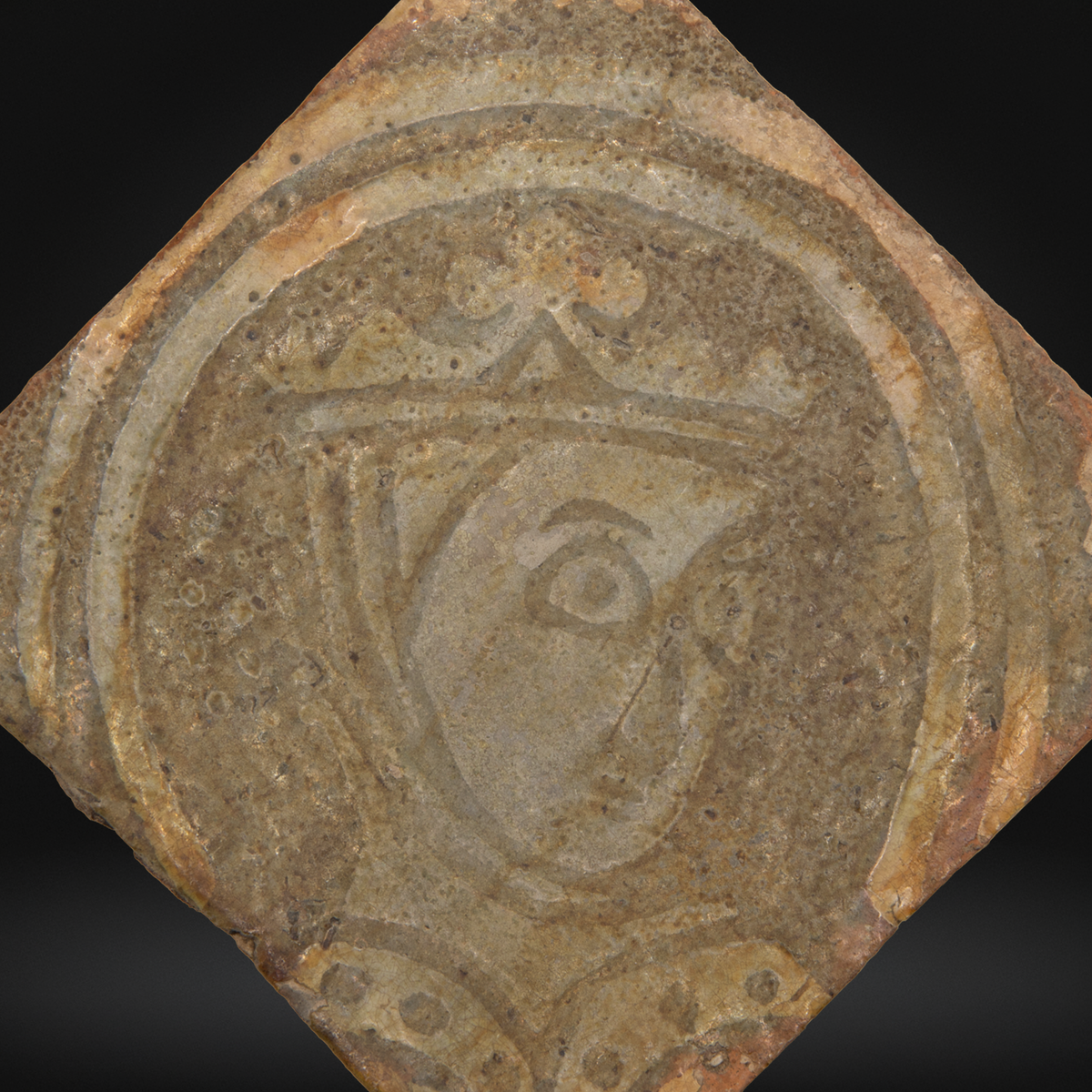
A exceptionally rare and particularly interesting pair of medieval lead-glazed earthenware floor tiles depicting the three-quarter busts of a crowned king and queen. Each portrait is enclosed within a lobe formed by double concentric lines, the designs intended to be combined with adjoining tiles to create a continuous quatrefoil pattern.
Both designs belong to the distinctive tradition of fourteenth-century figural tile production in Artois, northern France, where crowned heads formed part of elaborate decorative pavements in aristocratic and ecclesiastical buildings.
The male figure, classified as type BB IIa in the published typology of Artois tiles, is depicted in three-quarter profile with flowing, wavy hair, an ermine collar ornamented with small roundels and a crown embellished with a central cabochon. Closely related examples are recorded from Andres (No. 24), Hermelinghen (No. 185) and Dunes (No. 145). The latter was excavated at Notre-Dame de Saint-Omer, where it formed part of the decoration of an octagonal tower.
The companion female portrait is distinguished by her elaborate coiffure, with hair gathered beneath a netted or tasselled headdress, secured by a braided cord. She wears a fur-trimmed tunic, a jewelled collar and an ornamented crown. Corresponding examples are recorded from Hermelinghen (No. 183) and Thérouanne (No. 304). Jean Boucard has associated the hairstyle with courtly fashions of approximately 1365–1370, although the design belongs more broadly to the later fourteenth century.
The pairing of crowned male and female figures reflects the medieval taste for representations of royalty and nobility in architectural decoration. Such imagery was not confined to ceramic pavements: contemporary accounts record that the apartments of Count Robert II at Hesdin Castle were adorned with rows of sculpted plaster heads wearing gilded crowns.
An uncommon opportunity to acquire two complementary medieval figural tiles, representing the king and queen motifs of the Artois tradition. Together they provide an evocative illustration of the sophisticated Gothic decorative schemes employed in northern France during the fourteenth century.
c14th century, Northern France.
Each about 12cm : about 1.7cm thick
UK shipping included.
Condition: Chips and some loss and wear of the glaze. Long shallow section missing at the top right of the king & further chips. Sticker/glue remnants to the reverse.
Literature: Carette, Martine & Derœux, Didier. Carreaux de pavement médiévaux de Flandre et d'Artois (XIIIe–XIVe siècles). Arras: Commission départementale d'Histoire et d'Archéologie du Pas-de-Calais, 1985 p.72
Share